-
 Oceanus (Neptune), c. 1588/90
 -
Pietà , 1596
-
La Creazione del Mondo, dalle Metamorfosi di Ovidio GOD THE FATHER AND THE UNIVERSE, 1589
-
Hercules killing Cacus, 1588
-
Titus Manlius Torquatus, from "The Roman Heroes", 1586
-
Proserpine


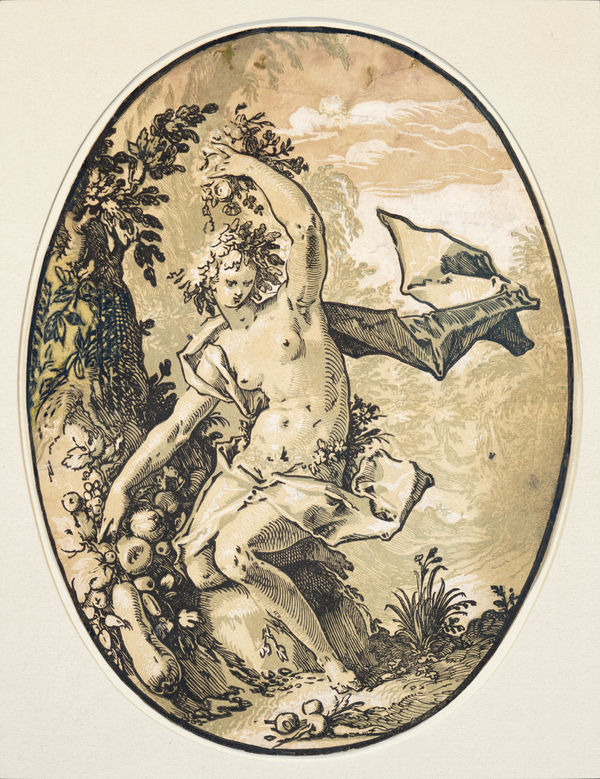

Hendrick Goltzius (1558-1617) is an eminent figure within the canon of 16th and 17th century art history. A pioneer of the Dutch Mannerist style, Goltzius was an illustrious engraver, printmaker and painter known for his ‘pen-painting’ technique and almost three-dimensional figures. Born in the Lower Rhine region of Germany, Goltzius belonged to a family of artists. As a child, his right hand had been burnt and he was unable to extend his fingers. Despite this, he went on to apprentice under engraver and printmaker, Dirck Volckertz Coornhert. He moved to Haarlem around 1578 and set up his own print publishing business which found great acclaim. He visited Italy in 1590-91, learning more about the Classical style and producing detailed studies of Renaissance sculptures. In 1600, Glotzius shifted to oil painting, with some speculators believing it to be due to his failing eyesight, while others asserting that he wanted to attain the highest esteem possible for artists at the time which could only be achieved through oil painting.
Goltzius is most famously known for his Mannerist prints, produced between 1585 and 1589, that featured the artist’s signature exaggerated forms, swelling lines and dramatic shadows. Taking inspiration from Flemish artist Bartholomeus Spranger, Goltzius utilised intricate cross hatching and tapering lines that created dynamic forms characteristic of the Mannerist school. After his trip to Italy, Goltzius began emulating the Renaissance artists, turning to realistic landscapes and proportions advocated by classical art, however, his love for mannerism is evident in his pen works. His Penwercken (pen works) were made by using a pen directly on the canvas to imitate printmaking, and featured distorted representations of the human body marked by artifice and high level of detail. Goltzius was popular among his contemporaries, not only for his innovative techniques, but also for his ability to imitate the Italian masters. His painting style is marked by eroticism as well as the classical influence of Rubens who visited Goltzius’ printmaking workshop in 1612.
-
Fail We May, Sail We Must
Exhibition 25 Sep 2026 - 7 Aug 2027 The Brown Collection, Marylebone, LondonThis autumn, The Brown Collection presents Fail We May, Sail We Must , a new exhibition full of works which reveal themselves as you look deeper within them. Curated by...Read more -
Hoi Polloi
Exhibition 24 Sep 2025 - 8 Aug 2026 The Brown Collection, Marylebone, LondonDiscover Hoi Polloi at The Brown Collection, Marylebone – an exhibition curated by Glenn Brown exploring how artists depict ‘the people’ from the 1500s to today.Read more -
The Laughing Stock of the Heartless Stars
Exhibition 12 Sep 2024 - 9 Aug 2025 The Brown Collection, Marylebone, LondonThe Brown Collection presents an exhibition by Glenn Brown exploring the tension between humanity and nature, meaning and absurdity. Featuring over 70 works from the 16th century to today, the show reflects on creation, decay and the cosmic unknown.Read more


National Gallery of Art. (2025). Hendrick Goltzius. [online] Available at: https://www.nga.gov/artists/2534-hendrick-goltzius [Accessed 4 Jul. 2026].
Orenstein, N.M. (2003). Hendrick Goltzius (1558–1617). [online] Metmuseum.org. Available at: https://www.metmuseum.org/essays/hendrick-goltzius-1558-1617 [Accessed 4 Jul. 2026].
The Metropolitan Museum of Art. (2003). Hendrick Goltzius, Dutch Master (1558–1617). [online] Available at: https://www.metmuseum.org/exhibitions/listings/2003/hendrick-goltzius.