-
 20.10.67, 1967
 -
Untitled, 11/01/67, 1967
-
Untitled, 1966
-
Untitled
-
Untitled


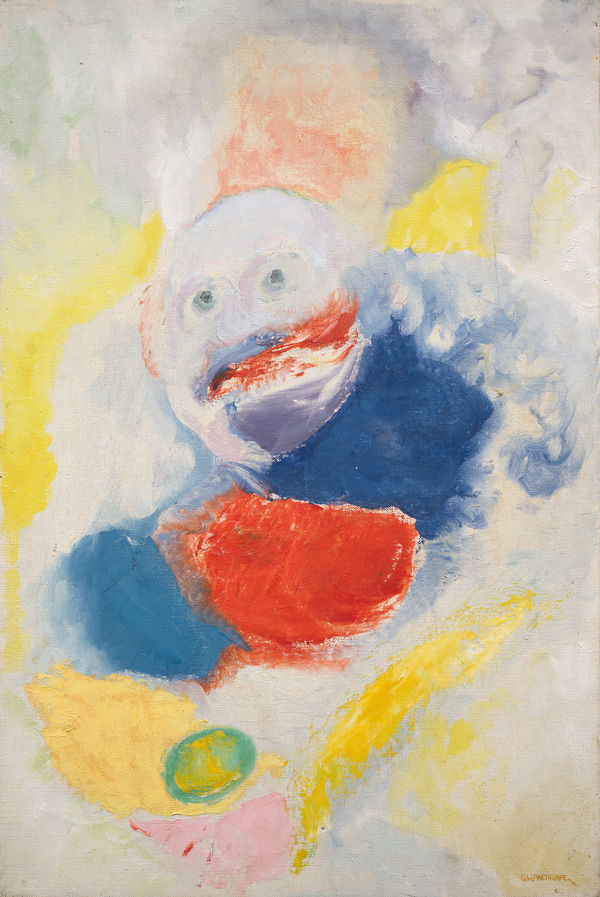
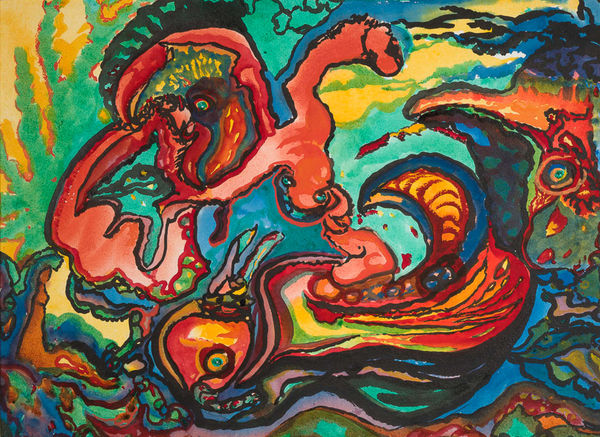

Dr Grace Winifred Pailthorpe (1883-1971) was a British surgeon and Surrealist artist who drew extensively on Freud’s theories of the unconscious in her scientific as well as artistic practice. A prominent figure in the British Surrealist Movement in the 1930s, Pailthorpe practiced ‘automatic’ art, which minimised interference from the conscious mind and tapped into subconscious emotions. Her use of watercolour was guided by the notion that watercolours capture the fluid nature of thoughts detached from rational critique while ink helped create vivid representations of trauma and repression.
Pailthorpe’s artistic practice was highly informed by her education as well as experience as a surgeon serving during World War I and after. Born in Sussex, Pailthorpe had nine brothers and grew up in an austere and puritanical household with a strict mother. She went on to attend the University of Durham and obtained a MBBS degree, which allowed her to serve in World War I. During her service as well as after the war, she travelled extensively, practicing in Australia for a few years and became an MD in 1924. It was in Australia that she developed an interest in criminology and upon her return to London in 1922, she began studying Freudian psychoanalysis under Ernest Jones. She became an associate member of the British Psychoanalytical Society in 1923 and editor of the International Journal of Psychoanalysis in the same year.
Deviating from conventional psychoanalysis, Pailthorpe encouraged her patients to paint and draw, and then conducted analysis of their art to draw inferences regarding their mental state. In 1935, she paired up with Reuben Mendikoff, an artist,designer and poet, to learn more about the relationship between the unconscious mind and Freudian theory. As part of this project, she began drawing and painting herself, using her own works in the research. Though she gained some formal training from Mendikoff, Pailthorpe’s style remained ‘naive’ and guided by her instincts. Through this project she developed a connection between her own ‘child-like’ art, her childhood trauma and Surrealist imagery. Both psychoanalysis and Surrealism relied upon the unconscious mind to express trauma, repression and fear through symbolic imagery. Pailthorpe asserted that Surrealist art was rooted in infantile trauma and desires, reflecting Freudian psychoanalytical theory. Through automatic art that was instinctual, the mind of the artist could be liberated.
In 1936, Pailthorpe was displayed in the International Surrealist Exhibition in London, a landmark exhibition that marked the advent of British Surrealist artists. In the same year, her works were displayed at the Kidderminster Art Gallery and Museum (1936) and were featured in the historic ‘Fantastic Art, Dada, Surrealism’ Exhibition (1936) at the Museum of Modern Art in New York. Pailthorpe continued to produce art and publish her research in the following years. In 1939, she and Mendikoff were jointly exhibited at the Guggenheim Jeune Gallery to much acclaim; however, their work was considered far too rooted in scientific inquiry rather than artistic pursuit. As World War II broke out, the Surrealist movement fractured and Pailthorpe renounced her association with the movement. She moved to New York alongside Mendikoff, and the couple later shifted to Vancouver where they organised Canada’s first Surrealist exhibition. The couple eventually returned to London where Pailthorpe continued her medical practice before passing away in 1971.
Bibliography
Montanaro, L.A. (2010). Surrealism and psychoanalysis in the work of Grace Pailthorpe and Reuben Mednikoff: 1935-1940. PhD Thesis, University of Edinburgh. United Kingdom.
Camden Art Centre (2019). A Tale of Mother’s Bones: Grace Pailthorpe, Reuben Mednikoff and the Birth of Psychorealism. [online] Camden Art Centre. Available at: https://camdenartcentre.org/whats-on/a-tale-of-mothers-bones-grace-pailthorpe-reuben-mednikoff-and-the-birth-of-psychorealism [Accessed 20 Jun. 2026].