Fail We May, Sail We Must : Exhibition

Six centuries of works which reveal themselves on a second look. Featured artists include Salvador Dalí, Marion Adnams, George Condo, Grace Pailthorpe, Fiona Rae, Glenn Brown, George Romney and Walter Sickert.
This autumn, The Brown Collection presents Fail We May, Sail We Must, a new exhibition full of works which reveal themselves as you look deeper within them.
Curated by British artist Glenn Brown and his husband and museum co-founder, Edgar Laguinia, the exhibition presents a collection of historic and contemporary paintings, sculpture, drawings, prints and ceramics, featuring spliced collages, double images and elongated and deceptive figures. Full of playfulness and humour, and spanning six centuries, the exhibition illustrates how art can challenge and reveal the workings of the mind.
Unfolding thematically across the museum's four floors, Fail We May, Sail We Must creates new connections between works that are not usually seen together.
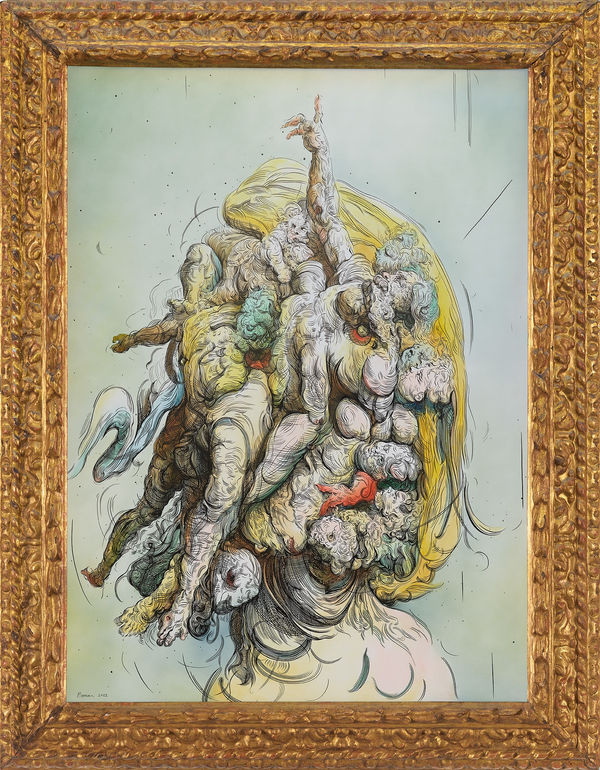
The ninety featured works slowly reveal their meanings to the attentive eye; Rebecca Warren's sculpture can appear both geological and anatomical; John Stezaker's collages splice postcards and film stills into a single, unstable image; Salvador Dalí's double images resolve into two parallel readings; Glenn Brown's giant head turns into a union of bodies and limbs.
The works can be perceived in multiple ways; our eye has to choose, and re-choose, what it sees, each time it lands. This trick is not just a product of modern art movements but is there in the elongated figures of 16th-century Mannerism and 20th-century Surrealism, where some of the most deliberate works are also the most unsettling.
The show includes grand portraits from the 17th, 18th, and 19th centuries, in which masterful representations of the human body reveal character and emotion and convey deeper messages. The exaggerated figures of Albert Victor Ormsby Wood, Jan Harmensz Muller and Hendrick Goltzius distort the body to express feeling; George Condo's portraits reference several viewpoints at once; Fiona Rae's brushstrokes and drips suggest figures and birds; and Philip Akkerman's decades-long practice of painting self-portraits multiplies a single face into hundreds of characters. Automatic drawing and dream imagery connect the Surrealism of Marion Adnams and Dado with the 1930s psychorealism of Grace Pailthorpe and Reuben Mednikoff.
Artists
- Marion Adnams (1898–1995)
- Philip Akkerman (b. 1957)
- Glenn Brown (b. 1966)
- George Condo (b. 1957)
- Dado (1933–2010)
- Salvador Dalí (1904–1989)
- Henri Fantin-Latour (1836–1904)
- Hendrick Goltzius (1558–1617)
- Ann-Marie James (b. 1981)
- Reuben Mednikoff (1906–1972)
- Jan Harmensz Muller (1571–1628)
- Grace Pailthorpe (1883–1971)
- Francis Picabia (1879–1953)
- Fiona Rae (b. 1963)
- Henry Raeburn (1756–1823)
- George Romney (1734–1802)
- Walter Sickert (1860–1942)
- Philip Wilson Steer (1860–1942)
- John Stezaker (b. 1949)
- Rebecca Warren (b. 1965)
- Albert Victor Ormsby Wood (1904–1977)
-
 Fiona Rae, Untitled (pale blue), 1990-1991
 -
Glenn Brown, Drawing VII (after Dali), 2026
-
Ann-Marie James, MUSÉE IMAGINAIRE, Plate 3, 2013
-
Glenn Brown, The Revolutionary Corps of Teenage Jesus, 2005
-
Marion Adnams, The Twins, 1953
-
Phillip Wilson Steer, Blue Period Portrait of a Lady, c. 1900
-
Glenn Brown, Fail We May, Sail We Must, 2022
-
George Condo, Untitled, 1999
-
Hendrick Goltzius, Hercules killing Cacus, 1588
-
Albert Victor Ormsby Wood, A maid and her charge, in the garden
-
John Stezaker, Mask (Film Portrait Collage) CCXIX, 2017




Related artists
-

Marion Adnams
-

Glenn Brown
-

George Condo
-

Hendrick Goltzius
-

Ann-Marie James
-

Fiona Rae
-

John Stezaker
-

Albert Victor Ormsby Wood